HTTP compression picker (@codecai/wire-compress)
Picks the right Content-Encoding for streaming responses based on client support and payload size. Framework-agnostic, zero dependencies, ~5 KB. The companion library every @codecai/* client and Codec-aware gateway uses to negotiate gzip / brotli / dict-zstd / identity.
@codecai/wire-compress is the small, framework-agnostic library that decides which Content-Encoding a streaming response should use. ~5 KB minified, zero runtime dependencies. It ships server-side pick() for choosing the encoding and client-side buildAcceptEncoding() for building the matching request header, both calibrated against the Codec v0.4.1 wire benchmark.
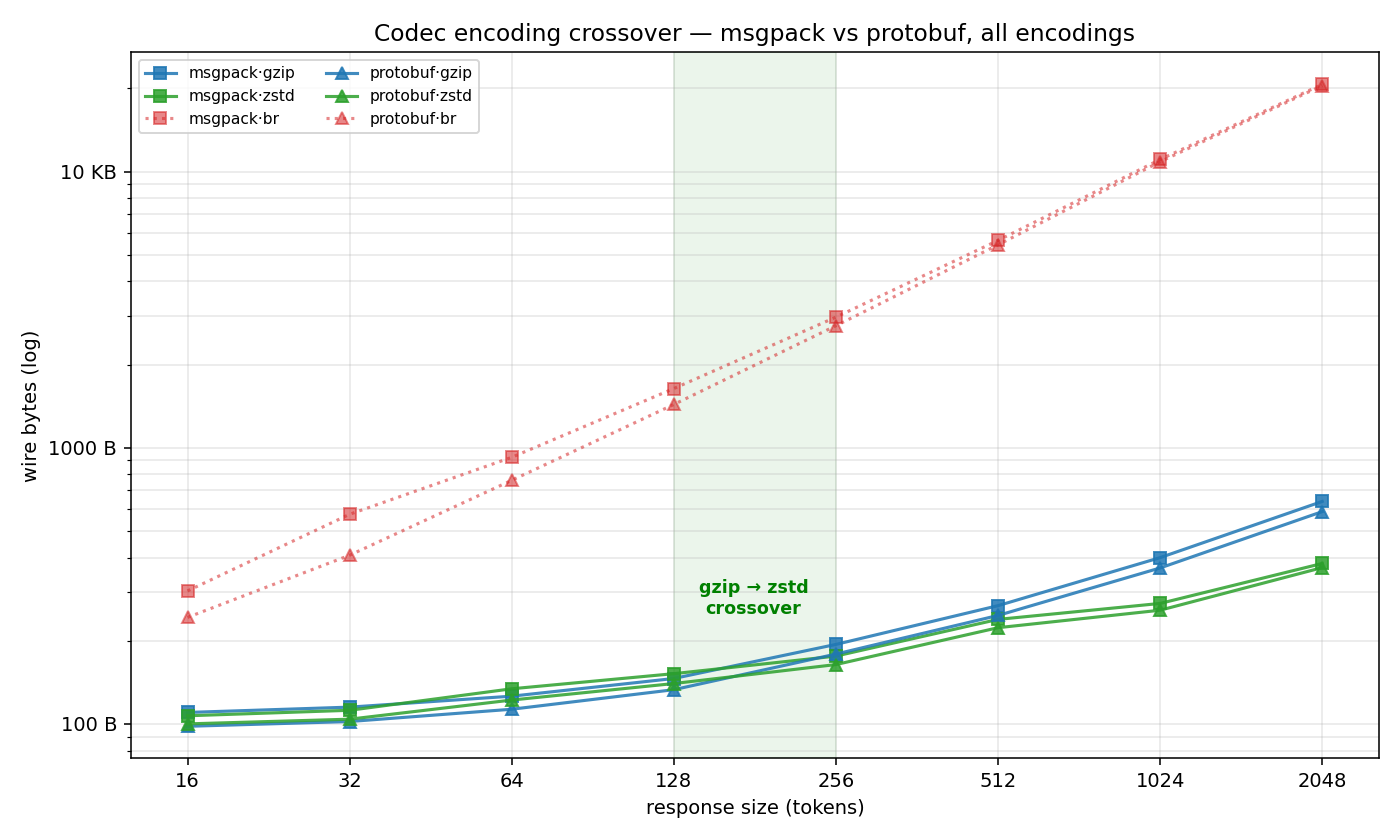
The conventional advice is “always brotli for HTTP.” That’s right for static web assets. It’s wrong for streaming responses with bursty small frames (SSE, Codec, gRPC-Web text, server-streamed JSON). Brotli’s per-block overhead doesn’t amortise across 10-25 byte frames; gzip and dict-zstd do. This package encodes the measured decision so you don’t have to relitigate it per server.
Install
npm install @codecai/wire-compressWorks with any HTTP framework (Express, Fastify, Hono, Node’s http, Bun, Deno, Cloudflare Workers). Pure functions, no middleware.
Server side (pick the encoding)
import { pick } from '@codecai/wire-compress';

app.get('/stream', (req, res) => {
  const dictForThisRequest = lookupZstdDict(req);
  const choice = pick({
    acceptEncoding: req.headers['accept-encoding'],
    estimatedSize: 1024,
    zstdHasDict: dictForThisRequest !== null,
    zstdEnabled: STREAMING_ZSTD_MIDDLEWARE,
  });
  if (choice.encoding !== 'identity') {
    res.setHeader('Content-Encoding', choice.encoding);
  }
  // ... apply the chosen compressor (with dict if zstd) and stream
});
The picker returns { encoding, reason }. reason is a human-readable log string explaining why this encoding was selected, useful when a deployment is debugging “why is the gateway not using zstd?” without having to instrument the decision tree by hand.
Client side (build Accept-Encoding)
import { buildAcceptEncoding } from '@codecai/wire-compress';

fetch('/stream', {
  headers: { 'Accept-Encoding': buildAcceptEncoding() },
  // → "gzip;q=1.0, br;q=0.5"           (zstd omitted by default)
});

// Opt into zstd only when you've confirmed (a) the server has a dict for
// this tokenizer and (b) the gateway streams (doesn't buffer):
fetch('/stream', {
  headers: { 'Accept-Encoding': buildAcceptEncoding({ zstd: true }) },
  // → "gzip;q=1.0, br;q=0.5, zstd;q=0.3"
});
The rule
| condition | encoding |
|---|---|
zstdHasDict && zstdEnabled && client accepts zstd | zstd |
| client accepts gzip | gzip |
| client accepts br only | br (fallback) |
| nothing else | identity |
Defaults are calibrated against measured streaming binary frames (Codec on sglang, see RESULTS.md §1c-1g in the parent repo).
zstd is dict-only
The picker enforces a hard rule: Content-Encoding: zstd is selected ONLY when both zstdHasDict and zstdEnabled are true. Either gate failing → fall through to gzip.
- Without a dict, no-dict zstd’s wire-byte advantage over gzip is essentially zero on Codec streams (both reach ≈3.4 B/token, within noise, see
RESULTS.md§1f), and on shipped middleware (sglang, vLLM/llama.cpp PR equivs) zstd buffers the whole response, regressing TTFB by 334× at 2K tokens. No-dict zstd is the worst of both worlds: same bytes as gzip, much worse TTFB. - With a dict + streaming middleware, dict-zstd beats gzip by 16-38% on bytes (
RESULTS.md§1g) at +0.13 ms streaming TTFB, sub-millisecond, dwarfed by network.
The dict isn’t an optimisation layered on top of zstd. It’s the precondition for zstd being on the menu at all.
What about brotli?
Brotli has wider client coverage than zstd. Safari, iOS, and older Firefox all ship br but not zstd. So brotli matters as a fallback. The picker reflects that:
- If client supports gzip → never use br (gzip wins on this workload at every size we measured).
- If client supports br but not gzip or zstd → use br. Strictly better than identity.
- If client supports nothing compressible → identity.
For the modern web (Chrome 123+, Firefox 126+) the picker lands on zstd; for older browsers and Safari it lands on gzip; br only kicks in for genuinely unusual clients that disabled gzip.
What about identity?
Identity loses at every size we measured. Even at 16 tokens, compressed Codec is ≥2× smaller than raw. The CPU cost of gzip/zstd on a single CodecFrame is sub-microsecond. So identity is only chosen when the client refuses everything else, or when you explicitly restrict serverSupports.
API
pick(input: PickInput): PickOutput
interface PickInput {
  acceptEncoding?: string | null;          // raw header value
  estimatedSize: number;                    // tokens or bytes (your unit)

  // Required for zstd to be a candidate (default false). Set per request:
  // true when the loaded tokenizer map's zstd_dictionaries[] has an entry
  // matching this response's stream_format.
  zstdHasDict?: boolean;

  // Required for zstd to be a candidate (default false). Set globally:
  // true when the gateway uses streaming-zstd-with-flush, not buffered
  // finalisation.
  zstdEnabled?: boolean;

  serverSupports?: Encoding[];              // restrict server-side capabilities
}

interface PickOutput {
  encoding: 'identity' | 'gzip' | 'br' | 'zstd';
  reason: string;                           // human-readable, for logs
}
parseAcceptEncoding(header): ClientSupport
RFC 7231 §5.3.4-compliant parser. Sorts entries by q-value descending, drops q=0 entries, respects identity;q=0 to disable identity, returns unspecified=true when the header is absent.
buildAcceptEncoding(opts?): string
Builds the recommended Accept-Encoding header for clients to send. Default order reflects the measured preference: zstd;q=1.0, gzip;q=0.9, br;q=0.5. Pass { zstd: false } etc. to omit individual encodings.
describeRule(t?): string
Pretty-prints the rule for log lines or --help output.
Why a separate package?
This logic is genuinely useful outside Codec. Anywhere you have:
- Streaming responses (SSE, gRPC-Web text, event streams)
- Many small frames, one blob each
- Mixed clients (modern browsers, mobile webviews, CLI tools, IoT)
…the right encoding depends on size and client support, and the standard “always-brotli” advice is wrong. Drop this in and skip writing your own switch statement.
The thresholds were measured for streaming token frames specifically. They generalise to other small-frame streaming workloads (chat APIs, log streams, telemetry) but you may want to recalibrate for your data.
Polyglot ports (same picker in C# and C)
The picker isn’t just a TypeScript module. The same Pareto-decision tree ships natively in Codec.Net (C#) and libcodec (C99), and every release replays the 12,960-vector cross-language conformance suite to assert all three implementations pick the same encoding for the same input.
| Language | Package | Public API entry | Test target |
|---|---|---|---|
| TypeScript | @codecai/wire-compress | pick({ ... }) | npm test in packages/wire-compress/ |
| C# / .NET 8+ | Codec.Net | Codec.Wire.Picker.Pick(new PickInput { ... }) | dotnet test, PickerConformanceTests |
| C99 | libcodec, CMake codec::codec target | codec_wire_pick(&in, &out) from codec/codec_wire_picker.h | ctest -R test_wire_picker |
Same hard rule across all three: dictless zstd is never chosen. Same PickReasonCode enum (dict_zstd_default, gzip_no_dict, per_stack_overrode_zstd, …). Same stack profiles (default, sglang, llama.cpp). The conformance suite walks 12,960 inputs (all 15 standard Accept-Encoding shapes × 9 payload sizes × 4 stack profiles × 4 flag combos × 2 interactivity modes × 3 sample profiles) and asserts byte-for-byte parity on (encoding, reason_code) for every vector. CI gates on it.
C# (Codec.Net)
using Codec.Wire;

var pick = Picker.Pick(new PickInput
{
    AcceptEncoding = request.Headers["Accept-Encoding"],
    EstimatedSize  = 1024,
    ZstdHasDict    = dictResolved is not null,
    ZstdEnabled    = streamingZstdConfirmed,
    StackProfile   = StackProfiles.For("sglang"),
});
if (pick.Encoding != Codec.Wire.Encoding.Identity)
    response.Headers["Content-Encoding"] = Picker.EncodingName(pick.Encoding);
Codec.Net targets net8.0 and ships the picker alongside the existing tokenizer / detokenizer / dict-zstd helpers. Brotli + gzip are built into the BCL (System.IO.Compression.BrotliStream / GZipStream); zstd is left to the caller’s choice of NuGet (ZstdSharp.Port is what the test project uses).
C (libcodec)
#include "codec/codec_wire_picker.h"

codec_wire_pick_input_t in = {
    .accept_encoding = request_header,
    .estimated_size  = 1024,
    .zstd_has_dict   = dict_resolved,
    .stack_profile   = codec_wire_profile_for("sglang"),
};
codec_wire_pick_result_t r;
codec_wire_pick(&in, &r);
if (r.encoding != CODEC_WIRE_ENC_IDENTITY)
    set_header("Content-Encoding", codec_wire_encoding_name(r.encoding));
No malloc, no thread-locals, no external runtime deps, suitable for ESP32 firmware hot paths and Linux server hot paths alike. Brotli / gzip / zstd link-in is the caller’s choice (libbrotli, zlib, libzstd); libcodec itself just owns the decision.
Source & links
- npm:
@codecai/wire-compress - NuGet:
Codec.Net(picker inCodec.Wire.Picker) - C:
packages/c/include/codec/codec_wire_picker.h - Source:
packages/wire-compress - Conformance vectors:
packages/wire-compress/test/conformance-vectors.json(12,960 cases) - Crossover chart:
packages/bench/docs/crossover-summary.png - Benchmark data:
packages/bench/RESULTS.md§1c-1g
See also
- Protocol » Compression, the wire-level negotiation this picker implements.
@codecai/web, the canonical TypeScript client; pairs with the picker for end-to-end compressed Codec streams.- codec-metamcp, the Codec-aware MCP gateway that uses this picker to negotiate encoding on tool-call results.